Heading out for summer vacation? Here's what Broward County pool owners need to do before they leave — and why skipping it can cost hundreds.
Share:

Summary:
You’ve booked the flights, packed the bags, and set the out-of-office message. The last thing on your mind should be your pool — but if you’re a Broward County homeowner, it probably is. And honestly, that instinct is right. Florida summers are not forgiving to unattended pools. Between the heat, the daily rain, and a UV index that eats through chlorine like it’s nothing, a pool that looked perfect on a Friday morning can look like a swamp by the time you land back at FLL two weeks later. Here’s what you actually need to do before you go — and why it matters more here than almost anywhere else.
Most homeowners assume their pool will hold up fine for a week or two. Set the timer on the pump, toss in a few extra chlorine tablets, and call it good. That logic works in a lot of places. It doesn’t really work here in Broward County.
Summer in Broward County means afternoon thunderstorms almost every day from June through September. Each rainstorm dilutes your water chemistry, drops the pH, and introduces pollen, debris, and organic matter that feeds algae. Meanwhile, the UV index is burning through your chlorine faster than the tablets can replace it. Within five to seven days — sometimes less — a pool without professional attention can go from clear to cloudy to fully green.
That’s not a hypothetical. It’s a pattern we see every summer across Broward County, from Coral Springs to Pembroke Pines to Weston.
Water chemistry is a balancing act under normal conditions. In South Florida’s summer, the variables multiply fast. High temperatures accelerate chemical reactions in the water, which means your chlorine gets consumed more quickly even without swimmers. Add in the UV exposure — which is significantly more intense here than in most of the country — and free chlorine levels can drop to unsafe levels within 24 to 48 hours of your last service visit.
Then there’s the rain. A typical Broward County afternoon storm can dump an inch or more of water into your pool in under an hour. That much fresh water doesn’t just raise the water level — it dilutes your sanitizer, shifts your pH, and introduces whatever was sitting on your deck, your screen enclosure, and your landscaping. If you’re near the Everglades corridor — communities like Davie, Southwest Ranches, or western Weston — you’re also dealing with higher organic loads from airborne pollen and insects that the rain carries in.
And if your pool is along the coast — Fort Lauderdale Beach, Pompano Beach, Lauderdale-by-the-Sea — salt air is quietly working on your equipment the entire time you’re gone. Pump housings, filter components, and electrical connections corrode faster in coastal environments, and a two-week absence without a pre-departure equipment check is a real risk.
The point is that pool maintenance in Broward County isn’t just about keeping things looking nice. It’s about staying ahead of conditions that move quickly and don’t wait for you to get back from vacation.
The most important thing you can do before a vacation is schedule a full service visit within 24 to 48 hours of your departure — not a week before, not the morning you leave. The goal is to have your water chemistry professionally tested and balanced as close to your departure as possible, so it’s starting from the best possible baseline.
A proper pre-vacation service visit should include a full water chemistry test — not a visual check, but an actual measurement of pH, total alkalinity, free chlorine, calcium hardness, and cyanuric acid levels. Each of those numbers affects the others, and a technician who holds a CPO (Certified Pool/Spa Operator) certification — the standard our team is trained to — knows how to read the full picture, not just adjust one number and hope the rest follows.
Beyond chemistry, the visit should include a thorough cleaning: surface skimming, vacuuming the pool floor, brushing the walls and steps to remove any early-stage biofilm, and cleaning out the skimmer and pump baskets. Algae doesn’t start as a green pool — it starts as a thin, invisible film on your walls that a brush breaks up before it can take hold. That brushing step is one of the most overlooked parts of a DIY pool routine, and it matters enormously when no one will be around to catch a problem early.
If you want extra protection during a longer absence, ask about a slow-dissolving chlorine stabilizer or an algaecide treatment timed for your departure. These aren’t substitutes for regular service while you’re away, but they buy time between visits and reduce the risk of a chemistry crash if something unexpected happens.
Want live answers?
Connect with a DCP Pool Services expert for fast, friendly support.
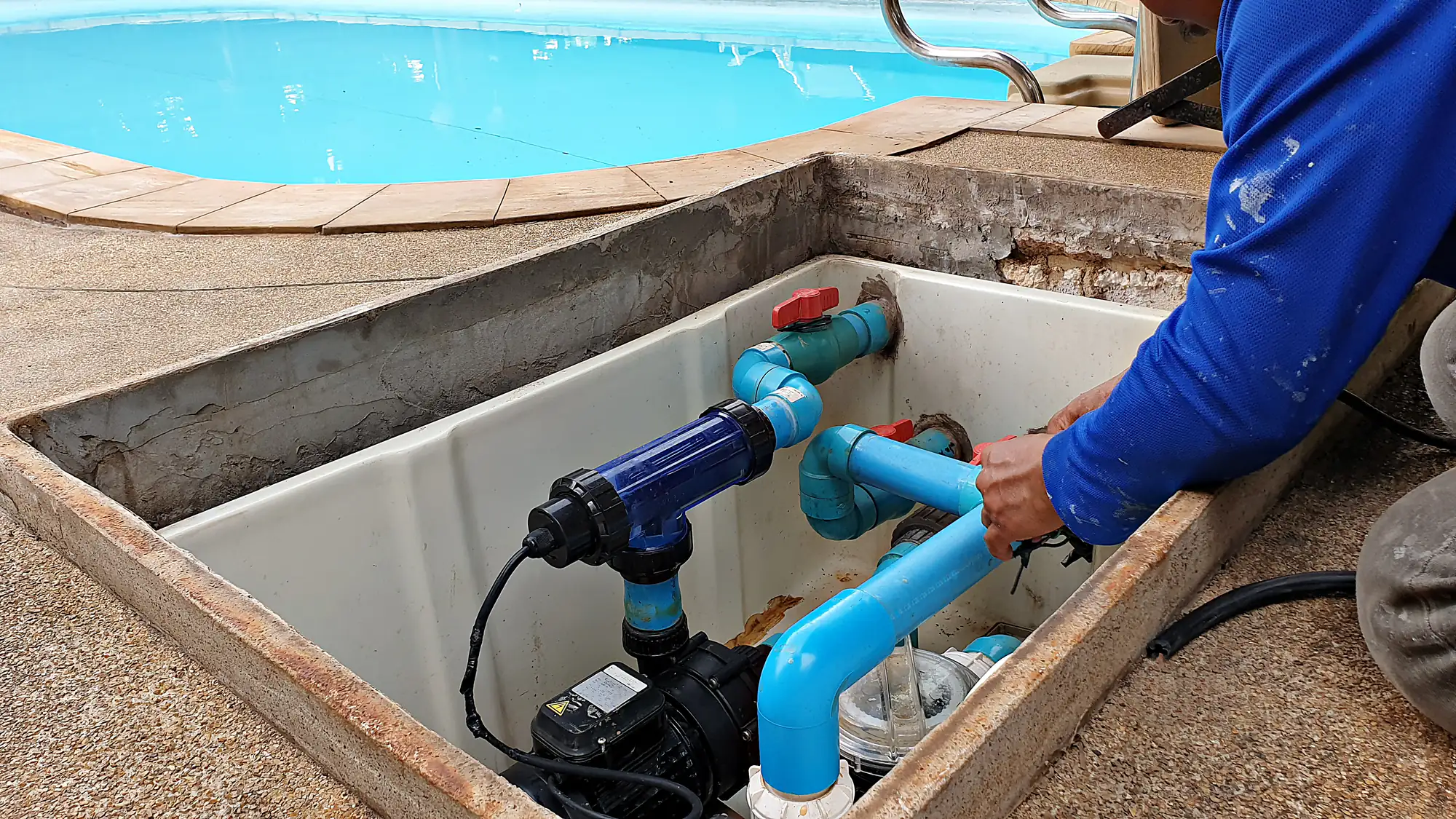
Your pool pump is the engine behind everything — circulation, filtration, sanitation. It moves 30,000 to 60,000 gallons of water through your system every day. When it’s running well, you don’t think about it. When it’s not, everything else breaks down fast.
The problem with pump failures is that they rarely happen all at once. They give warnings first — a grinding or screeching sound, a rattling noise, reduced suction, water that seems slower to clear after a storm. Most homeowners notice these signs and file them under “I’ll deal with that later.” Leaving for a two-week vacation with a pump that’s already showing stress is one of the more expensive mistakes we see in this business.
A pre-vacation equipment inspection takes less time than you’d think and can save you from coming home to a failed pump, a stalled filtration system, and a pool that’s been sitting without circulation for two weeks.
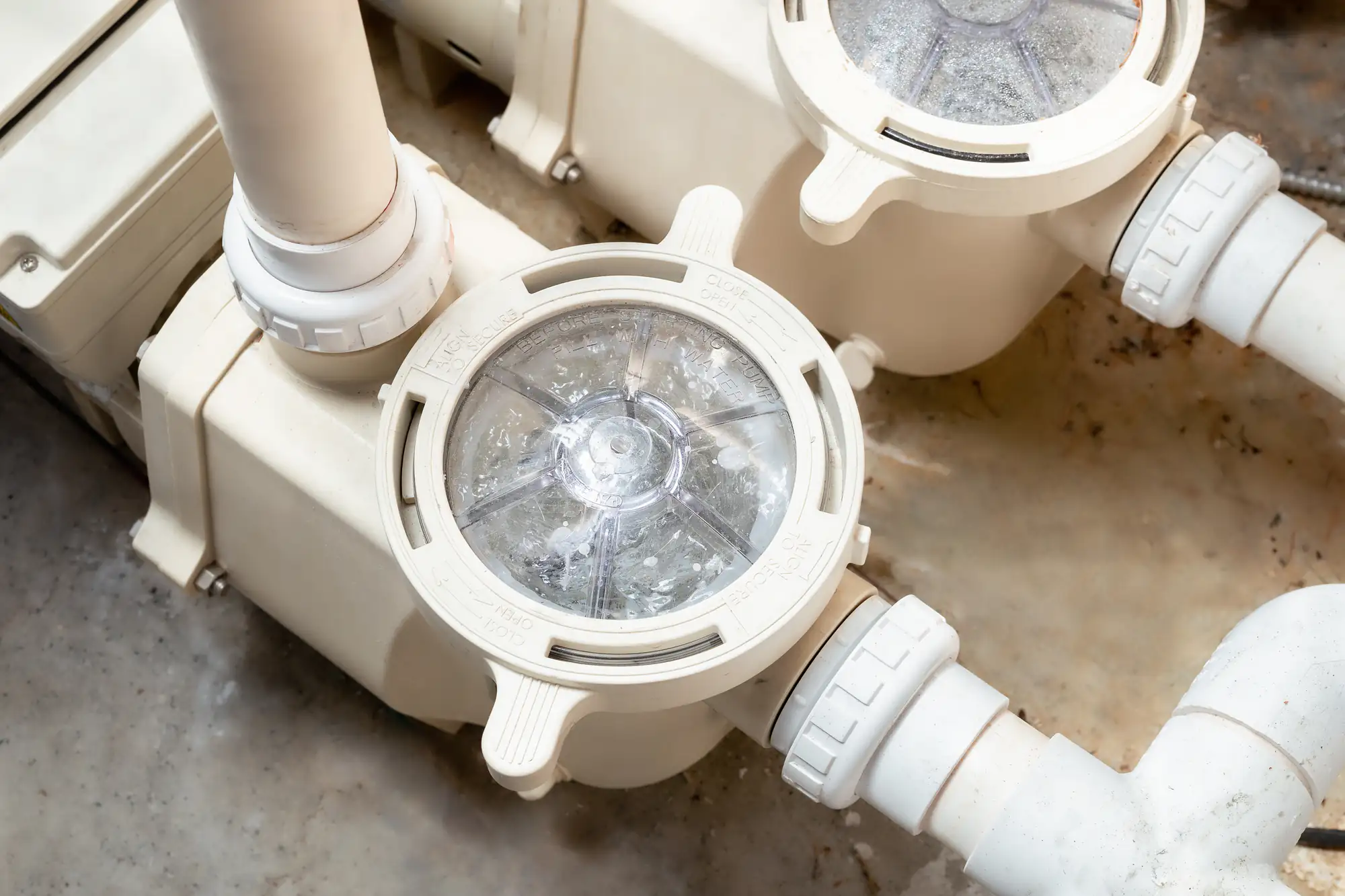
Most pump problems don’t announce themselves dramatically. They build gradually, and because the pump is usually tucked away on the equipment pad, homeowners often don’t notice until something has already gone wrong. Before any extended absence, it’s worth taking a few minutes to actually listen to your pump and observe how your pool is responding.
A healthy pump runs with a consistent, relatively quiet hum. If you’re hearing grinding, it usually points to worn bearings — a mechanical issue that will eventually seize the motor entirely. Rattling often means debris has gotten into the impeller and is disrupting flow. A high-pitched screeching sound is a common sign that the motor is overheating or that internal components are failing. Any of these sounds, on their own, is a reason to have someone look at it before you leave.
Beyond sound, watch for changes in water clarity. If your pool seems slower to clear after a storm, or if the water looks slightly hazy even after a service visit, reduced pump performance could be the cause. A pump that’s losing suction isn’t filtering effectively, and a pool with poor circulation is a pool that’s one hot, rainy week away from an algae bloom.
For homeowners in older Broward County neighborhoods — many of the residential pools in areas like Plantation, Tamarac, and Lauderhill were built in the 1970s and 1980s — aging equipment is a real consideration. A pump that’s been running for 15 or 20 years may be functional day-to-day but not resilient enough to handle two unsupervised weeks in the middle of a South Florida summer. Pool pump repair or proactive replacement before a vacation isn’t an upsell — it’s genuinely the smarter financial move compared to emergency pool repair when you return.
This is one of the most common questions we hear from Broward County homeowners heading out for summer travel, and the answer is more nuanced than a simple yes or no.
Running your pump on a timer is standard practice and generally the right approach. Most pools in South Florida do well with eight to twelve hours of circulation per day under normal conditions. During a vacation, especially in peak summer, bumping that up slightly — to ten or twelve hours — gives your filtration system more time to process any debris or organic matter that accumulates between service visits. It also keeps water moving, which makes it harder for algae to establish.
What you should not do is assume that a running pump means everything is fine. A pump can run on its timer while developing a problem, while the filter pressure climbs too high from accumulated debris, or while a slow chemical imbalance goes unchecked. The pump being on is a necessary condition for a healthy pool — it’s not a sufficient one.
The most practical setup for a vacation is to have your pump timer properly adjusted before you leave, combined with at least one professional service visit during your absence. For a trip of ten days or longer, two visits is the more conservative and sensible approach in this climate. Weekly pool maintenance exists for a reason — the service interval was designed around how quickly conditions change in Florida, and that timeline doesn’t pause because you’re out of town.
One more thing worth mentioning: if you have a variable-speed pump, make sure the programming is correct before you leave. A pump running at the wrong speed setting can either underperform on filtration or run up your electricity bill unnecessarily. It’s a small thing to verify, but it’s the kind of detail that a professional service visit will catch automatically.
The reality of pool ownership in South Florida is that the maintenance window between “fine” and “problem” is shorter than most people expect — and it shrinks even faster when you’re not home. A pre-vacation service visit, a properly set pump timer, balanced water chemistry, and at least one check-in visit while you’re away will protect your pool through the worst of what a Broward County summer can throw at it.
None of this has to be complicated or stressful. That’s exactly what professional pool maintenance is for — so you can leave for the airport without wondering what you’re coming home to.
If you’re heading out this summer and want your pool in the right hands while you’re gone, reach out to us at DCP Pool Services. We serve homeowners across Broward County — from Coral Springs and Weston to Fort Lauderdale, Hollywood, and everywhere in between — and we’ll make sure your water is just as clear when you get back as the day you left.
Article details:
Share:
Continue learning: