Florida summers are brutal on pools. Here's what Broward County homeowners actually need to know about keeping their water clean, safe, and ready to swim in.
Share:
Summary:
Summer in Broward County means one thing for pool owners: the stakes just went up. The UV index is extreme, the afternoon storms are relentless, and your pool is getting more use than it has all year. That combination is genuinely hard on water chemistry — and on equipment.
Most of the homeowners we talk to aren’t neglectful. They’re just busy. And they’re not always sure whether what they’re doing is enough, or whether the pool they’re leaving behind while they travel to the Keys for two weeks is going to be a green swamp when they get home.
Here’s what you actually need to know.
The honest answer is weekly. Not because that’s what we want to sell you, but because Broward County’s summer climate makes anything less than that genuinely risky.
When the UV index hits 10 or 11 — which it does regularly in South Florida from June through September — it burns through chlorine at a rate that most people don’t expect. Levels that were fine on Monday can be dangerously low by Thursday. Add in the afternoon rainstorms that dilute your chemistry and introduce organic contaminants, and you have a situation where a lot can go sideways in a very short window.
Weekly service isn’t a luxury in Broward County. It’s the maintenance interval the climate actually demands.
This is where things get expensive fast. Broward County’s rainy season runs from June through September, and it doesn’t just bring water — it brings diluted chemistry, lower pH, and a flood of organic material into your pool. After a heavy rain event, your chlorine levels can drop significantly, your pH can swing acidic, and the warm water creates near-ideal conditions for algae to establish itself.
Algae doesn’t take long in our summer heat. What looks like a faint green tinge on the walls Monday morning can be a full bloom by the weekend. Once you’re there, you’re not just adding a little shock and calling it done. A proper green pool remediation involves testing the water first, applying the right type and amount of treatment, running extended filtration cycles, brushing the walls and floor repeatedly, and following up over several days. That process can run anywhere from $150 to $400 or more — sometimes higher depending on how far gone the pool is.
Compare that to a monthly maintenance plan, and the math is pretty clear.
There’s also the equipment side of the equation. When chemistry is off for an extended period, it doesn’t just affect the water — it affects your surfaces, your seals, your pump, and your filter. Corrosive water quietly does damage that you won’t notice until it shows up as a repair bill. Keeping chemistry balanced week to week is one of the simplest ways to extend the life of everything connected to your pool.
If you’re in a neighborhood with a heavy tree canopy — Davie, Plantation, parts of Coral Springs — you’re also dealing with leaves, pollen, and debris that accelerate the problem. That organic matter consumes chlorine and feeds algae. Weekly skimming, vacuuming, and brushing aren’t just cosmetic. They’re part of what keeps the chemistry manageable.
For most residential pools in Broward County, weekly service is the standard and it holds up well through summer. But there are situations where bumping to more frequent visits makes sense, and it’s worth knowing when you’re in one of them.
High bather load is the most common reason. If your pool is getting heavy use through June, July, and August — kids home from school, regular guests, weekend gatherings — you’re introducing significantly more contaminants into the water. Sunscreen, body oils, and sweat all consume chlorine and stress your filtration system. The pool that was easy to maintain in April with two adults using it occasionally is a different challenge when six people are in it every afternoon.
Pools with saltwater systems can also need closer attention during peak heat. Salt chlorine generators work harder in warmer water, and the output needs to be monitored more carefully to ensure chlorine levels stay in range.
If you live near the coast — Fort Lauderdale Beach, Hallandale Beach, Lauderdale-by-the-Sea — salt air is an additional factor. It accelerates corrosion on pool equipment and metal components, which means equipment inspections during service visits matter more, not less.
For most homeowners, a well-executed weekly maintenance visit covers everything: water testing and chemical balancing, skimming, vacuuming, wall and step brushing, skimmer basket cleaning, and an equipment check. That last part — the equipment check — is something that gets skipped more often than it should when people try to manage maintenance themselves. Catching a pump that’s running hot or a filter that’s due for a deep clean during a routine visit is how you avoid a mid-summer repair emergency.
Want live answers?
Connect with a DCP Pool Services expert for fast, friendly support.
Your pump is the engine of the whole system. When it’s working, you don’t think about it. When it’s not, everything else stops working too — and in Broward County’s summer heat, the window between “minor issue” and “full failure” can be surprisingly short.
Heat stress on pool pumps spikes during the hottest months of the year. South Florida regularly sees temperatures in the low-to-mid 90s with heat indices above 100°F, and pumps that are already running harder to circulate warmer water are operating under real strain. This is when the warning signs tend to show up — and when it’s worth paying attention to them.
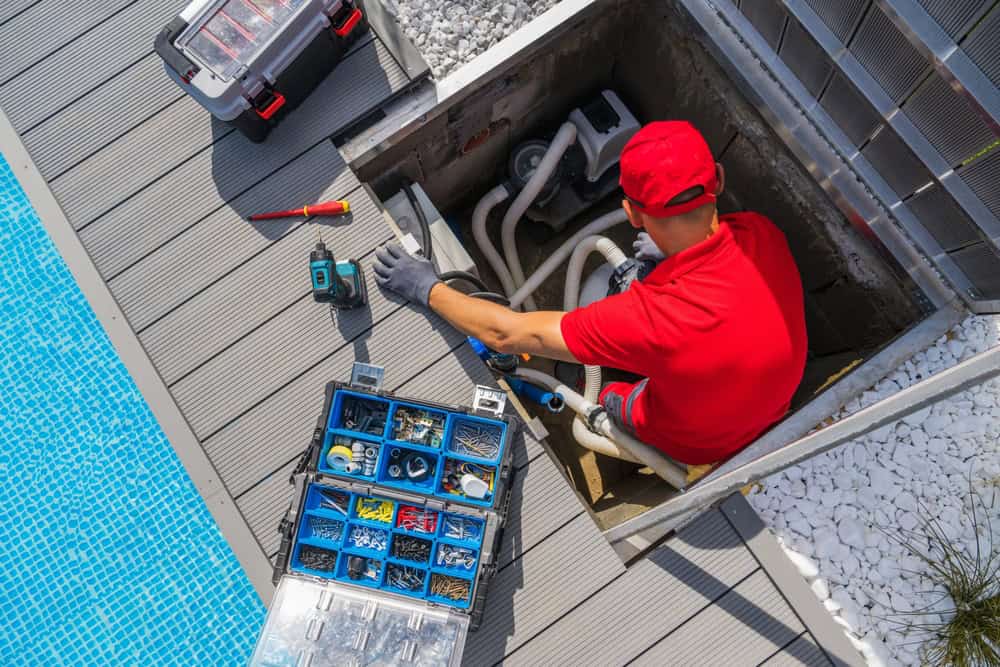
Grinding, whining, or screeching sounds coming from your pump aren’t something to monitor and see how it goes. Those noises are mechanical warning signs — worn bearings, a failing motor, cavitation from restricted water flow — and they tend to get worse, not better, on their own.
Other things worth paying attention to: if your pump is running but the water isn’t circulating the way it normally does, if you’re noticing air bubbles returning through the return jets, or if the pump is shutting off on its own, those are all signals that something needs to be looked at. A pump that’s losing prime repeatedly usually has a suction-side issue — a leak, a clogged basket, or a failing seal — that’s worth diagnosing before the motor burns out trying to compensate.
The cost difference between catching a pump problem early and dealing with a complete failure is significant. A repair that addresses a worn seal or a failing capacitor is a fraction of what a full pump replacement costs. And if the pump fails in the middle of summer and the pool goes stagnant for even a few days, you’re looking at water remediation on top of the equipment repair.
We use Pentair and Hayward parts for all pump repairs — the same brands most residential pools in Broward County were built with. That matters because using off-brand components can affect performance and, in some cases, void manufacturer warranties on other equipment in the system.
When we find a pump issue during a routine maintenance visit, we can address it then and there. You don’t need to schedule a separate service call and wait another week while the problem gets worse. That’s one of the practical advantages of having the same team handle your weekly maintenance and your equipment repairs.
This is one of the most common questions we get from homeowners in Broward County, especially from June through August when summer travel peaks. The short version: don’t leave without a plan, and don’t assume the pool will hold for two weeks on its own.
A Florida pool left without service for two weeks in summer is almost certain to develop problems. The chemistry shifts, the chlorine depletes, and the warm water does what warm water does — it grows things. Coming home to a green pool after a vacation isn’t just frustrating. It’s expensive, and it takes days to fully resolve.
The smartest move is to make sure your scheduled service falls as close to your departure date as possible, and that we know you’ll be away. A good technician will do a thorough chemical balance before you leave, check the equipment, and ensure the filtration system is running properly. If your travel window spans more than a week, a mid-trip visit is worth scheduling — not because something will definitely go wrong, but because the cost of prevention is a fraction of the cost of remediation.
If you’re in a community with HOA requirements — Weston, Parkland, parts of Pembroke Pines and Coral Springs — a neglected pool while you’re traveling isn’t just a maintenance issue. A visibly green or poorly maintained pool can trigger HOA violations and fines. That’s a headache nobody wants to come home to.
For homeowners who travel frequently, or for snowbirds who own a Broward County property but aren’t here year-round, a consistent weekly maintenance plan is the most reliable way to protect the pool and the investment behind it. We handle the chemistry, the equipment checks, and the debris removal every week — whether you’re home or not.
Florida summers don’t give pool owners much margin for error. The heat, the rain, the UV intensity, and the sheer amount of use your pool gets between Memorial Day and Labor Day all add up to a maintenance environment that’s more demanding than most people realize until something goes wrong.
Weekly professional service, a watchful eye on your equipment, and a solid plan before you travel — those three things cover the vast majority of what Broward County pool owners actually need to stay ahead of problems instead of reacting to them.
If you’re looking for a team that shows up consistently, tells you upfront what things cost, and can handle both routine maintenance and repairs without sending you to a second company, reach out to us. We’re locally based in Broward County, CPO-certified, and we’ve been taking care of pools across this area long enough to know exactly what this climate asks of them.
Article details:
Share:
Continue learning:
Ready for a Pool You'll Love?
Contact us today for a free quote!
DCP Pool Services
Company
Useful Links