Strange noises from your pool pump are never just background noise — here's what they mean and what to do about them in Broward County.
Share:
Summary:
You walk out to your pool, and something sounds off. Maybe it’s a grinding you didn’t notice last week. Maybe it’s a high-pitched whine that kicks in every time the pump starts up. Or maybe the pump sounds fine but the water just isn’t moving the way it should.
Whatever it is, you’re not sure if it’s serious — and you’re not sure who to call. That uncertainty is exactly what this page is for. We’ll walk through the most common pool pump problems we see across Broward County, what they actually mean, and how to figure out whether you’re looking at a quick fix or something bigger.
The sound your pump is making tells you a lot — if you know what to listen for. Most homeowners describe three types of noise: a grinding or growling, a high-pitched squeal or screech, and a hum with no movement. Each one points to something different, and each one carries a different level of urgency.
A grinding or growling noise almost always comes from worn motor bearings. Bearings are what allow the motor shaft to spin smoothly, and over time — especially in Broward County’s heat and humidity — they dry out, corrode, or pit. When that happens, metal grinds against metal. You’ll notice the sound gets louder as the motor warms up. Don’t run it like this longer than you have to.

A high-pitched squeal or screech is usually a shaft seal starting to fail. The shaft seal sits at the point where the motor connects to the pump housing, and its job is to keep water from getting into the motor. When it starts to go, you’ll often see a small drip of water right at that joint — and you’ll hear that telltale screech when the pump runs.
Left alone, a failing shaft seal becomes a failed shaft seal. Water gets into the motor windings, and now you’re not just replacing a seal — you’re replacing a motor. In Broward County, where humidity is already working against you, moisture intrusion into a motor housing accelerates faster than it would in a drier climate. It’s one of those repairs that’s inexpensive when caught early and expensive when it isn’t.
We’ll replace the seal, inspect the full pump assembly, and if the motor shows signs of moisture damage, we’ll tell you that before any work begins — not after. That’s just how an honest repair conversation should go.
If the pump is making a humming sound but not actually starting, the likely culprit is a failed start capacitor. The capacitor is what gives the motor its initial electrical jolt to spin up. When it fails, the motor tries to start, hums, and then either trips the breaker or just sits there. Capacitors are relatively inexpensive to replace, but they involve live electrical components — this isn’t a DIY job.
One thing worth knowing: if your pump is more than eight years old and the bearings or capacitor are failing, it’s worth having a real conversation about whether repair or full replacement makes more financial sense. A pump that’s had one component fail at eight years has likely accumulated wear across the whole system. We’ll walk you through both options with actual numbers so you can decide — not guess.
A gurgling, sucking, or air-spitting sound from your pump is a sign of cavitation — the pump isn’t getting enough water to do its job. It’s pulling air instead of water, and that’s hard on the impeller and the motor both. The most common causes are a clogged skimmer basket, water level that’s dropped too low, or an air leak somewhere on the suction side of the plumbing.
Start with the obvious: check the skimmer basket and make sure the water level is at least halfway up the skimmer opening. If both of those look fine and the gurgling continues, you likely have an air leak — a crack in a fitting, a worn lid o-ring, or a loose union. Air leaks on the suction side are sneaky because the pump still appears to be running. It is running. It’s just not circulating water effectively.
This matters more in Broward County than most people realize. When your pump isn’t actually moving water — even if it sounds like it’s working — your pool’s filtration stops. In South Florida’s climate, that’s not a situation you can leave for a few days. Algae can establish in a pool within 24 to 48 hours when circulation fails during the summer months. What starts as a gurgling pump can become a green pool faster than you’d expect, especially in communities like Weston, Davie, and Coral Springs where pools sit in full sun most of the day.
A rattling or vibrating pump is usually a simpler story: debris in the impeller, a loose mounting bolt, or the pump sitting on an uneven pad. Post-storm calls for rattling pumps are common across Broward County after tropical systems push through — leaves, twigs, and debris get pulled through the skimmer and straight into the impeller housing. It’s often a quick fix, but it still needs attention before it causes secondary damage.
Want live answers?
Connect with a DCP Pool Services expert for fast, friendly support.
Beyond the noise itself, most homeowners have the same handful of questions once they realize something’s wrong. We hear these constantly — from Fort Lauderdale to Hollywood to Pembroke Pines — and they’re worth answering directly.
The biggest one is almost always some version of: “Do I actually need a new pump, or is someone going to try to sell me one I don’t need?” It’s a fair question. The pool service industry doesn’t have the best reputation for transparency, and replacing a whole pump when only a capacitor or bearing needs attention is unfortunately not unheard of.
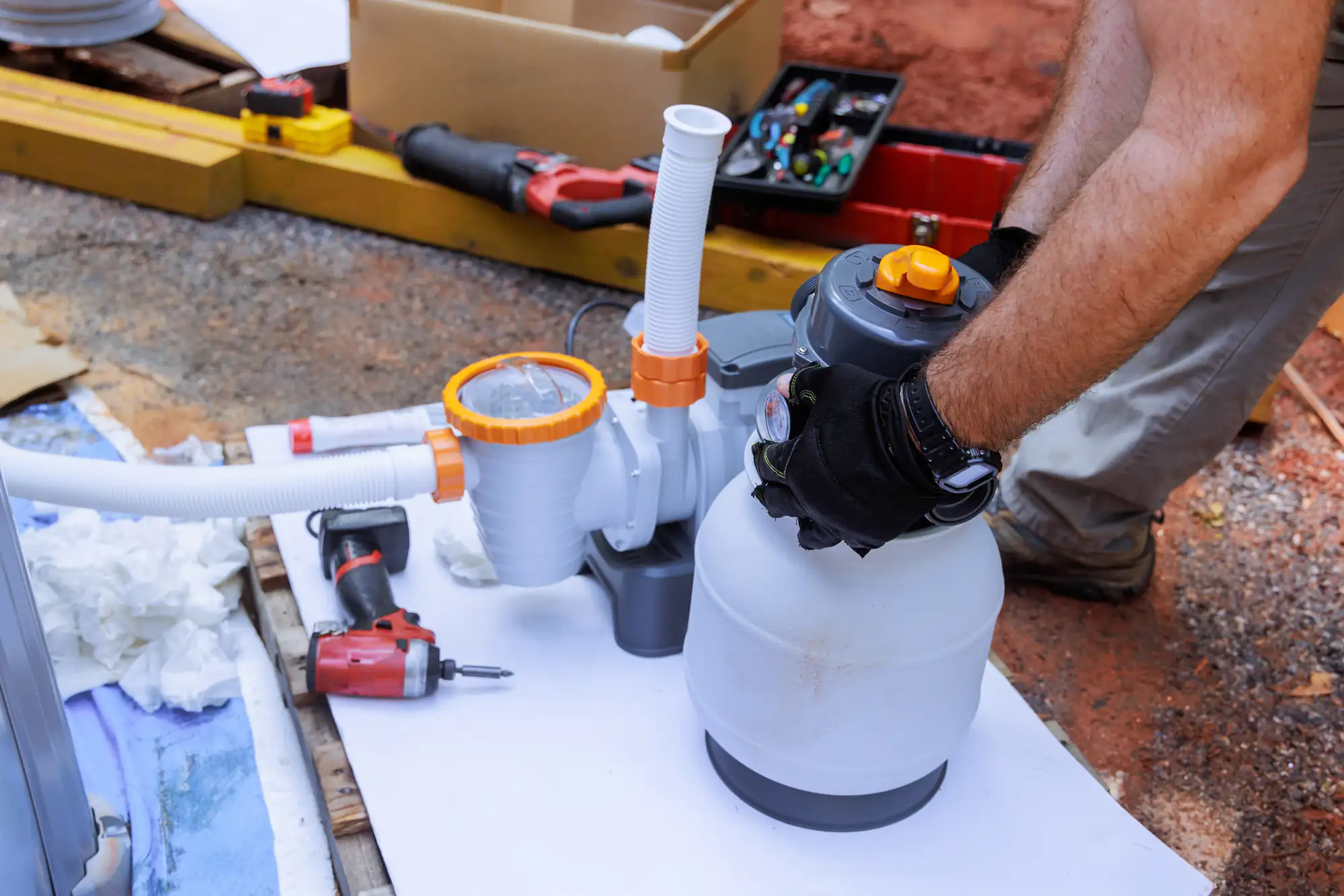
The honest answer depends on two things: the age of the pump and what’s actually failing. A well-maintained pool pump lasts eight to twelve years. In Broward County, where pumps run every single day of the year — not four months like up north — that timeline can compress. Continuous operation in heat and humidity puts more cumulative stress on bearings, seals, and motor windings than seasonal use ever would.
If your pump is under eight years old and one component has failed — a capacitor, a shaft seal, a set of bearings — repair almost always makes sense. A capacitor replacement might cost $50 to $150 in parts. A motor replacement runs $300 to $600 depending on the unit. That’s a very different conversation from a full pump replacement, which can run $800 to $1,500 or more.
If the pump is over eight years old and the bearings are gone, the math shifts. Bearings can be replaced, but an eight-year-old motor that’s been running in Broward County’s conditions has likely accumulated wear that goes beyond the bearings alone. At that point, a full replacement — ideally with a variable-speed pump — often delivers better long-term value than putting money into an aging motor.
Here’s where the energy savings conversation becomes relevant. Florida Atlantic University’s Center for Energy Conservation, based right in Boca Raton, studied 120 Florida pools and found that homeowners saved up to 75% of their pumping costs with energy-efficient equipment. One documented case: a Broward County homeowner who upgraded from a 1.5 HP single-speed to a variable-speed model reduced their annual pump costs from $890 to $195 — a savings of nearly $700 per year, with the pump paying for itself in under two years. If your pump is aging and your FPL bill has been climbing, that context matters when you’re deciding whether to repair or replace.
We’ll give you both numbers upfront. What the repair costs, what a replacement costs, and what a variable-speed upgrade would likely save you annually. Then you decide.
Yes — and this is one of the most important questions you can ask before anyone touches your equipment. In Florida, replacing a pool pump motor or performing equipment repairs requires a contractor license issued by the Florida Department of Business and Professional Regulation. The specific license type is a Certified Pool/Spa Contractor (CPC) license. Without it, a technician can identify that your pump needs replacing, but they cannot legally perform that replacement.
This matters for a few reasons. Under Florida Statute 489.128, you have the right to refuse payment for services performed by an unlicensed contractor. More practically, work done by an unlicensed technician may void your equipment warranty and could create issues with your homeowner’s insurance if something goes wrong afterward.
Our license number is CPC-1460991. You can verify it yourself at MyFloridaLicense.com — just search the number. We’d actually encourage you to do that before calling any pool company in Broward County, not just us. A business tax ID is not a contractor’s license. A CPO certification alone is not a contractor’s license. If a company can’t give you a CPC license number, they can’t legally replace your pump.
Speaking of CPO certification — we hold that too. The Certified Pool/Spa Operator credential is the industry’s standard for pool professionals and is required in Florida for anyone maintaining water quality and chemical balance at a public pool. It means our technicians understand the full system, not just the mechanical parts. When we diagnose a pump issue, we’re also thinking about how that pump’s performance affects your water chemistry, your filter, and your overall circulation — because those things don’t exist in isolation.
One more thing worth mentioning: Florida contractor licenses require renewal every two years, with 14 hours of continuing education per cycle. That’s not just paperwork — it means licensed contractors stay current on code changes, equipment standards, and the DOE’s evolving energy efficiency regulations for pool pumps. The industry is changing, and the technician working on your equipment should know that.
A noisy pool pump is your equipment telling you something. In most cases, catching it early means the difference between a straightforward, affordable repair and a much larger problem — a seized motor, a compromised filter system, or a pool that’s turned green while you were waiting to see if the noise would go away on its own. In Broward County’s climate, waiting rarely works in your favor.
The good news is that most pump issues are fixable, most repairs cost less than homeowners expect, and a clear diagnosis doesn’t have to come with a sales pitch attached. You deserve a straight answer about what’s wrong and what it costs to fix it — before any work begins.
If your pump is making noise, running but not circulating properly, or tripping the breaker, reach out to us. We serve homeowners across Fort Lauderdale, Hollywood, Pembroke Pines, Coral Springs, Miramar, Plantation, Sunrise, Davie, and the rest of Broward County, FL — and we’ll tell you exactly what you’re dealing with.
Article details:
Share:
Continue learning: